JOURNAL
DECEMBER 2012
Featuring the prize-winning and finalist essays
from our postgraduate writing competition
CONTENTS
03 |! Welcome from Evgeny Lebedev
04 |! Editor’s Introduction
05 |! Russian Art and Culture Writing Competition
05 |! Judging Panel
! PRIZE WINNERS
07 |! Alise Tifentale (City University of New York) - First Prize
! The Peasant Woman Leads the Dance: Some Ambiguities Presented by Vera Mukhina’s S! culpture
16 |! Maria Starkova-Vindman (Courtauld Institute of Art, London) - Second Prize
! Us or Them? Sovietisation of Non-Russian Children in Early Soviet Periodicals
! FINALISTS
21 |! Margarita Vaysman (Wadham College, University of Oxford)
! Komar and Melamid’s Chernyshevsky concept
24 |! Charlotte Gill (University of Durham)
! Kandinsky: A Shamanic Seer or a Mystical Cynic?
32 |! Yana Myaskovskaya (Smithsonian Institution/George Mason University, Washington D.C)
! A Return to Tradition: The Role of the Russian Folklore Revival in Fedor Rückert’s Miniature
! Enamel Paintings
37 |! Amy Martin (Courtauld Institute of Art, London)
! Olga Rozanova: Queen of the Folk Amazons
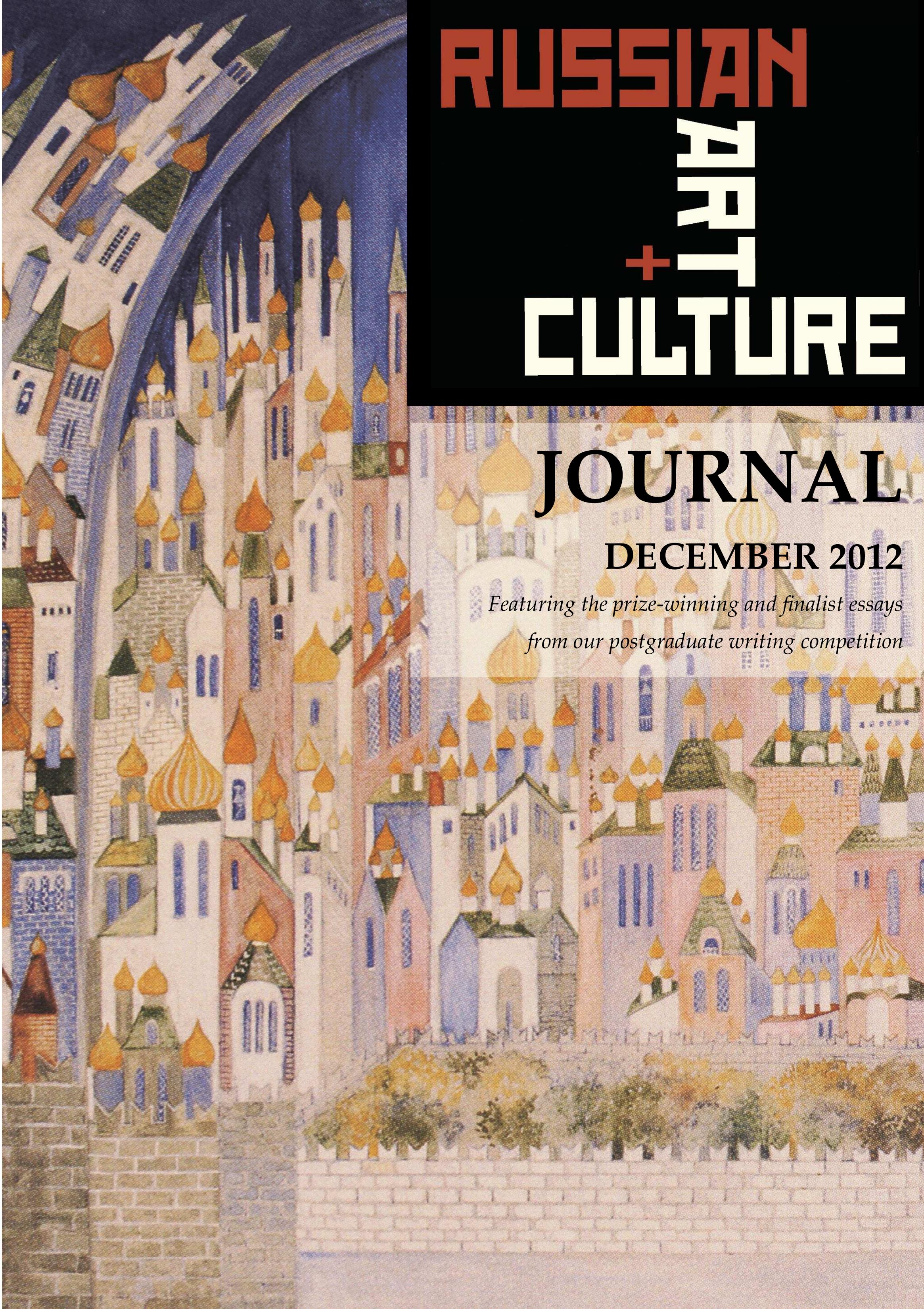
Russian Art and Culture / Journal, December 2012 / Front cover artwork: Natalia Goncharova, Backcloth design for the Finale, The Firebird, c.
1926 (Collection of Nikita Lobanov-Rostovsky) / Page 4 artwork: Mikhail Larionov, Stage design with group of dancers and mask on floor, Le
Soleil de Nuit, 1915 (Collection of Nikita Lobanov-Rostovsky) / Design: rdgsmith.co.uk
Contact: (Theodora Clarke)
[email protected] / Website: www.russianartandculture.com
2|
RUSSIAN ART AND CULTURE WRITING cOMPETITION
First prize this year has been awarded to Alise Tifentale, a PhD student at the City University of New
York. Her essay ‘The Peasant Woman Leads the Dance’ focused on the ambiguities present in the Soviet
female sculptor Vera Mukhina.
Second prize was awarded to Maria Starkova, a PhD student at the Courtauld Institute of Art in London.
Her essay ‘Us or Them?’ focused on the Sovietisation of non-Russian children in early Soviet periodicals.
“Tifentale’s essay is a lively reappraisal of an able and important sculptor whose work was dominated by Stalinist
interpretations. However, underlying it was an original and powerful modern sculpture. As women and sculpture
are underrepresented in art history as a whole, it makes it useful to have a fresh view now that Communism is over.
This essay also gives Mukhina an international context”.
Professor John Milner
"Her essay has a good analysis of the role of peasant woman in Soviet Russia. It should provide an interesting and
exciting read to anyone interested in Russian art and culture”.
Dr. Natalia Murray
"Starkova’s essay is an intensively erudite piece of writing. It is a precise, meticulous analysis of Soviet cultural
aims since through the lens of the Pioneer movement. This essay is impressive in its analysis of material. It is an
original, very under researched subject. Also I appreciated how very difficult it was to condense such a large body of
material from a PhD thesis and to reshape for a general audience.”
Professor John Milner
“Her essay was of a very high standard”.
Dr. Natalia Murray
JUDGING PANEL
Professor John Milner has been engaged with Russian art since
completing his PhD at the Courtauld Institute in the 1970s. His book
on the constructivist Vladimir Tatlin opened up the poetic and
speculative aspects of Tatlin’s work and personality. John Milner has
also written on Malevich, on Rodchenko and various other Russian
themes, and has also curated a major display of work by El Lissitzky
at the Stedelijk Van Abbemuseum in Eindhoven. In 2010 he curated
an exhibition at the ArtSensus Gallery in London of Rodchenko and
his Circle, focussing on Rodchenko’s photography in the context of
contemporary, professionally trained photographer-journalists who
worked for Novosti and other Soviet agencies.
He has for a number of years taught Masters and doctoral students
in Russian art at the Courtauld Institute of Art, and in 2011 together
with Dr Rosalind Polly Blakesley of the Department of Art History at
Cambridge University, he founded the Cambridge Courtauld
Russian Art Centre to encourage collaboration on the study of Russian art through conferences,
including Art in Exile as well as Utopia I, II and III in 2011-12, which have attracted many scholars from
Russia, from across Europe and the United States. But CCRAC also encourages contacts with Russian
scholars, curators, and mutual study visits that encourage research in this field.
|5
Dr. Maria Mileeva has recently completed her PhD at the
Courtauld Institute of Art, where she currently teaches courses on
Russian twentieth century art at both graduate and
undergraduate level. Her doctoral thesis examined exhibitions of
Western art in the Soviet Union in the 1920s and 1930s with a
particular focus on the history of the State Museum of New
Western Art (GMNZI), Moscow. Previously, she read Art History
at Jesus College, Cambridge. Maria has also worked as an
Assistant Curator of ‘Cold War Modern: Design 1945-1970’, held
at the Victoria and Albert Museum, London in autumn 2008.
Her research interests include cultural exchange between Russia
and the West over the course of the 20th century, with particular
focus on the politics of international exhibition design and the
construction of art historical narratives as a means of defining
national identity and cultural policy. Her latest research project
explores the discourse of centre and periphery in Soviet cultural
and institutional history by looking at a network of regional art museums in the peripheral outposts of
Tbilisi, Yerevan, Baku, Kiev, Kharkov, Saratov and Kazan. She is the administrator of the Cambridge
Courtauld Russian Art Centre (CCRAC).
Dr. Natalia Murray was born in St Petersburg where she
read Art History at the Academy of Fine Arts before
taking the PhD course at the Hermitage Museum.
In 1998 she moved to England; over the past five years
she has been lecturing on XIX-XX c. Russian Art at the
Courtauld Institute of Art and at the University of
Sussex.
Natalia’s biography of Nikolay Punin, The Unsung Hero of
the Russian Avant-Garde. The Life and Times of Nikolay
Punin (1888-1953), was published by Brill Academic
Publishers in June 2012.
Theodora Clarke is Editor of Russian Art and Culture and founder of
Russian Art Week in London. She is an art historian and lecturer
specialising in Russian art and European modernism. She lectures
widely on twentieth-century avant-garde painting and sculpture to
audiences across the UK at museums, galleries, universities and
associations. She has previously lectured at institutions which include
the Victoria & Albert Museum, Tate Britain, Harvard University, the
Courtauld Institute of Art, the University of Bristol and Cambridge
University. Theodora has also taught adult art history courses at the
Royal West of England Academy.
Theodora previously worked at Christie’s and the Museum of Modern
Art in New York. She is currently a PhD candidate at the University of
Bristol. She did her Masters at the Courtauld Institute of Art (2008) and
obtained a First at Newcastle University for her undergraduate degree.
Harvard University awarded her a dissertation grant in 2011.
6|
The Peasant Woman Leads the Dance: Some
Ambiguities Presented by Vera Mukhina’s
Sculpture
Alise Tifentale (City University of New York)
“Male art is rather weak in the show, / Where to flee from the female domination?
Mukhina’s baba overcame everybody / By sole might and with no effort.”
Leonid Sobinov1
Russian sculptor Vera Mukhina (1889-1953) is most widely known as the artist of the grandiose stainless-
steel sculpture Worker and Collective Farm Woman (1937), which crowned the Soviet pavilion in the Paris
International Exposition of 1937, strategically located opposite the German pavilion. However, Boris
Iofan, the architect of the Soviet pavilion, should be credited for the idea of the sculpture; Mukhina won
the competition for the implementation of Iofan's sketch and supervised its technical realization
(together with two other female sculptors, Nina Zelenskaya and Zinaida Ivanova). Nevertheless,
Mukhina’s interpretation was revolutionary.2
Therefore most of what has been published on Mukhina during the last decades, both in her native
Russia and in the West, focuses on the Soviet pavilion in Paris,3 although it has not yet inspired such a
rigorous and enlightening study as Karen Fiss’s book on the German pavilion.4 At the same time, the
scope of contemporary research dealing with Mukhina’s oeuvre in general or with artist’s other works is
rather limited.5
One of rare exceptions is an article by Bettina Jungen, “Vera Mukhina: Art between Modernism and
Socialist Realism,” published in Third Text in 2009. This essay focusses on a sculpture by Mukhina,
Peasant Woman (1927). As the previous most recent considerably detailed analysis of this work published
in English dates back to 1953,6 Peasant Woman presents several challenges for an art historian.
In this article I am addressing some of the issues raised by Jungen, especially the opposition between the
formalistic and politicized readings of the Peasant Woman. In addition, this article views Mukhina’s
sculpture in terms of gender and class notions of the ideological background from which it emerged.
Finally, I also discuss the artist’s relationship with the official art establishment in these terms as well,
considering Mukhina’s upbringing in a pre-Revolution bourgeois family and her career as one of few
female artists in the theoretically emancipated but in reality largely patriarchal Soviet officialdom. By
identifying some ambiguities in the current criticism and interpretations of Soviet official art, I hope to
propose some perspectives for further inquiry that would lead to a thorough understanding of the
contradictory and multilayered history of the official art in the Soviet Union.
Vera Mukhina’s sculpture Peasant Woman is a commissioned piece for the exhibition held in Moscow in
1927 in honor of the 10th anniversary of the Russian Revolution. Do works commissioned by state-
sponsored institutions automatically become carriers of this state’s ideology, even when no direct
political or ideological message can be clearly read from the work? Formally speaking, there may be
nothing unequivocally “national socialistic” in Arno Breker’s idealized female and male nudes, nothing
specifically “fascist” in the rows of obelisks of Via della Conciliazione in Rome, as well as nothing
unambiguously “soviet” in Mukhina’s Peasant Woman. As Jungen has put it, “the formal solution is
neither a specifically Russian nor Soviet one.”7 At the same time, Jungen points out that “the artist did
not originally conceive the sheaves of grain with the sickle; these were demanded later by the
competition commission as attributes of agricultural labor.”8 This discovery becomes of utmost
importance when discussing relationships between artist and patron in a totalitarian regime.
Indeed, Soviet official art in the West usually is analyzed in political terms.9 Even if the ideological
|7
connotations of official Soviet art, which leading scholars of the field have discussed at length,10 are
dismissed in this particular case, the integration of art within the functions of state and party plays a
significant role. The fact that a competition committee could intervene directly in an artwork’s content
and form, contradicts the modernist idea of artistic autonomy and individual creative expression in art,
and seems to support politicized and ideological readings of all Soviet official art, including Peasant
Woman.
Yet, Jungen rightfully warns about the “danger of understanding such works of art solely in the context
of Soviet ideology.”11 The author mentions Olga Kostina’s essay where she “perceived the ‘hypertrophic
brutality of massive form’ and the ‘almost aggressive self-confidence’ of the Peasant Woman as an
ideological sign of the totalitarian era and an anticipation of the kolkhoz peasantry.”12 To oppose this
politicized reading, Jungen suggests that Mukhina’s Peasant Woman should be interpreted as a modernist
work of art, especially in “the neoclassical tendencies of French and Russian modernism.”13
Mukhina definitely was exposed to French neoclassicism during her stay in Paris (1912-1914), when she
worked in Antoine Bourdelle’s studio. After returning to Russia, Mukhina also was familiar with avant-
garde ideas developed by her contemporaries. Artists such as Gustav Klutsis, El Lissitzky, and others
rejected representation and experimented with sculpture and three-dimensional objects.14 Some critics
have argued against a Paris-centered view in this period and declared that the first two decades of the
20th century was the first time when Russian artists did not follow influences from the West. Instead,
they themselves “formed part of the avant-garde of world culture” oriented against realism.15 An
example of Mukhina’s exploration of sculptural language outside the neoclassical tradition is the Flame
of the Revolution (1923), a proposal for a monument to Yakov Sverdlov, communist party leader and the
head of Soviet Russia (1917-1919).
However, similar Cubist and Futurist influence16 would not reappear in Mukhina’s sculpture again.
Mukhina’s preference of less radical approach in the late 1920s seems to coincide with neoclassicism in
general assuming a leading position in Soviet official art, a tendency that eventually will lead to the
establishment of Socialist Realism dogma as the method of Soviet art in 1934.17
In this context, Peasant Woman can be seen as a proto-Socialist Realism achievement.18 At the same time,
it is possible to view it as a neoclassicist work. Jungen turns attention to the archaic trend in works of
Mukhina’s teacher Bourdelle, among whose sculptures “many heavy-limbed and heroic female figures
could be found.”19 Jungen particularly refers to Bourdelle’s Penelope (1907-1912).20 Although Mukhina’s
Bather (1927) shows Bourdelle’s influence, the Peasant Woman stands out. The confrontational, self-
assured, and maybe even ironic image of the Peasant Woman seems to be rather removed from
Bourdelle’s inward-looking, contemplative, and melancholic Penelope and majority of his female figures.
Vera Mukhina had mentioned her respect for the work of Aristide Maillol.21 Jungen in her article points
to Maillol’s Pomona (1910). Even though some formal affinities between Pomona and Peasant Woman are
obvious, so are their differences, especially in their respective methods of gender construction. The grace
and nudity of Pomona and other visually pleasing Maillol sculptures could be seen as corresponding to
mostly male viewers’ fantasies of total possession of a woman’s body, rendered submissive and available
for infinite observation. Quite contrarily, Mukhina’s Peasant Woman is neither graceful nor nude, and
absolutely not submissive. Her stance seems independent, active, and thus even threatening to a male
viewer, her crossed hands and exaggerated feet implying a dominating presence. At this point it even
seems possible to agree with some Soviet art critics, Mukhina’s contemporaries. For instance, Petr
Suzdalev characterized the Peasant Woman as “promoting a new and idealized view of the beauty of the
Soviet working woman of the 1920s.”22 David Arkin openly juxtaposed Mukhina’s work to that of
Maillol, whose Pomona he called “a fanciful blend of early 20th century Paris and neoclassicism,”
victoriously noting that “Peasant Woman was free of all such stylization or affectation.”23
Peasant Woman succeeds in avoiding a direct reference to the classical canons of female beauty as
expressed in works of Bourdelle, Maillol, and other Western male sculptors. It appears as an exception in
the endless row of nude and draped female figures produced in the classical guise of Venuses and
8|
Aphrodites. Mukhina’s sculpture does not replicate the classical Western idea of femininity. It rejects
softness, melancholy, eroticism or sensuousness, fragility, weakness, and elegance of the classical female
figure. Rather it is an image of a certain independence and empowerment of a woman. It also can be
seen as an idealized embodiment of Soviet policy of emancipation and thus a device of ideological
propaganda. As Jungen has put it, “The official view was that Mukhina’s Peasant Woman supported the
concerns of Soviet politics. She was seen as the embodiment of a healthy, strong and proud peasantry
that stood for her country. She also represented the Soviet woman’s new self-confidence and willingness
to give her heart and soul to her land.”24
Curiously enough, some of the comments made by male contemporaries betray the still patriarchal
society where emancipation and gender equality was just another theoretical construction, not yet
accepted or understood. For instance, painter and teacher Ilya Mashkov’s comment that “such a woman
gives birth while standing, without uttering a sound”25 does not seem to praise the sculpture itself, it
rather expresses male viewer’s reaction to an image of superhuman, almighty idea of Soviet femininity.
The poem by Mukhina’s brother-in-law, famous opera singer Leonid Sobinov also does not seem to
comment on the sculpture’s artistic merit but instead comments on the obviously unexpected
masculinity and strength of the female image: “Mukhina’s baba overcame everybody by sole might and
with no effort.”26
Quite untranslatable Russian word baba in Sobinov’s poem opens up whole avenues of further
discussion. Baba is a colloquial word,27 generally used by male speakers describing females. It has a
pejorative sound, and is used also as a swearword to address a man whose behavior is unmanly, or
woman-like. Even more important, baba brings in volumes of Russian history and innumerable layers of
gender, social, economic, and political constructions that were challenged right at the time when
Mukhina created her Peasant Woman. The figure’s attire and especially one significant detail – her
headscarf knotted under the chin – could have encouraged contemporaries to call her a baba.
Jungen refers to iconography of Soviet mass propaganda imagery from the late 1920s as studied by
Victoria Bonnell and argues that “the progressive peasant woman was characterized by a headscarf
knotted at the back, the way it was usually found in the iconography of women factory workers.”28
Peasant Woman with her scarf knotted under the chin seems to ignore the current attributes of a
progressive Soviet peasant woman. Furthermore, during this decade a peasant woman alone could
hardly embody a progressive idea – if women appeared in Soviet political visual communication, then
only as secondary and subordinate to men, and most often as urban factory workers, not peasants.29
According to Bonnell, “the peasant woman presented the most complex and controversial image in the
lexicon of Soviet political art.”30 Thus Peasant Woman presents herself as an exception in the context of
Soviet popular imagery of the decade – a rather heroic female image in time when male role models
dominate, and a peasant among factory workers.
The headscarf of Peasant Woman refers to the traditional, pre-revolutionary peasant woman or the baba
who would not have invoked idyllic associations. Scholars agree on the deprived status of rural women
in Russia before and also after the Revolution that had created the baba.31 The baba was a symbol of “the
‘darkest,’ most backward layer of the Russian population, a dead weight and a potential source of
counterrevolution,”32 or, in other words, “the baba was not perceived as the fairer sex, but as the darker
sector of the already dark peasant masses.”33 Lynne Viola adds that the baba is “illiterate, ignorant (in the
broader sense nekul’turnaia [uncivilized]), superstitious, a rumor-monger, and, in general, given into
irrational outbursts of hysteria.”34 Bonnell concludes that baba “signif[ied] the wretched, brutal, and
patriarchal world of the peasant wife, who was subordinated to husband, priest, and police. When
someone proposed outlawing the word baba at the first All-Russian congress of Women in November
1918, the audience roared its approval.”35
Clearly, the taboo word baba in post-revolutionary Russia connoted not only gender, but also class. The
year when the Peasant Woman was created and exhibited “marked the beginning of the end of the New
Economic Policy (NEP) and the reemergence of repression as the basic modus operandi for Soviet rule in
|9
the countryside.”36 Lenin’s class struggle ideology, originating from Marx’s and Engels’ observations in
the industrial city, was projected onto Russian rural communities, thus legitimizing the elimination of
economically more successful peasantry (so-called kulaks)37 and leading to collectivization. The reform
“aimed at breaking down the old byt’ – the complex of customs, beliefs, and manners that determined
the peasant’s daily life.”38 This reform was not necessarily perceived as something positive, even though
“at the simplest level Soviet culture meant hygiene and health care, and knives and forks rather than a
wooden spoon dipping into a common bowl, a remarkable message to a peasant who may customarily
have left human excrement to pile up around the hut.”39 Quite paradoxically, the most oppressed part of
the peasantry – women – also played the most important role in opposing the reforms brought by the
New Economic Policy.40
Then who is Mukhina’s Peasant Woman with her retrograde headscarf of a baba? She seems not to be an
oppressed, humiliated, and enslaved baba anymore, but also not yet a progressive rabotnitsa (factory
worker) or a kolkhoznitsa (collective farm woman). Jungen argues that Mukhina was “unconcerned with
showing either progressive or retrogressive peasantry, or the engaged woman of collectivization.”41 The
author believes that Peasant Woman is “an ambivalent figure whose meaning oscillates between
propagandistic definitiveness and neo-classical generalization.”42
Yet Mukhina’s career poses further questions about the relationship between an artist and the official art
establishment of the Stalinist regime. Mukhina was born in a merchant’s family in Riga, one of the
westernmost cities of tsarist Russia. Her upper middle class upbringing included studying art in Paris
and spending summers in a holiday house in Crimea. After the Revolution she could have been
denounced as bourgeois – an enemy of the proletariat – and persecuted. However, Mukhina had proved
her loyalty to the new Soviet state in the first post-revolutionary years, also by taking part in “the
monumental propaganda” program initiated by Lenin.43 In her diaries the artist had mentioned giving
up inherited family properties for the benefit of the revolutionary government.44
The tsarist bourgeois milieu of Mukhina’s childhood and youth after the Revolution was replaced by its
opposite, a society ruled by the communist party in the name of proletariat. The experience of two
radically different worlds can be relevant to interpretations of Peasant Woman. For instance, Yelena
Vasilyevskaya argues that “in this commissioned sculpture one can clearly feel a view from another
social environment, mixed with fear and awe. (. . . ) [the sculpture] symbolized self-confident power of a
new class allowing for no compromises. (. . . ) The goddess of abundance that the sculptress tried to
represent turned into a severe and unyielding defender of the fruit of peasants’ labor.”45
Even though Mukhina had convincingly proved her loyalty to the Soviet government, she was not a
member of the communist party and maintained friendships with “prosecuted artists.”46 Considering
these facts, Jungen suggests that “Mukhina was never an obsequious state artist, but her social ideals
and artistic forms were instrumentalised by the propaganda of the Soviet regime.”47 This paradox
presents another ambiguity related to life and career of Vera Mukhina (and many other artists working
within Soviet official art establishment) in need of further research and clarification. Even without
becoming a member of communist party, Mukhina had a rather successful career. Besides Peasant Woman
the artist received numerous other state-sponsored commissions, including portraits of academicians
and Red Army heroes, such as portraits of Colonel Bari Yusupov (1942) and Ivan Khizhnyak (1942).
Mukhina received prestigious awards, such as several Stalin Prizes, orders, and the honorary title
People’s Artist of the Union of Soviet Socialist Republics. She lectured in VKHUTEIN (The Higher
Institute of Arts and Technology, a Soviet analogue of Bauhaus in a sense),48 and she was elected a
member of the executive council of the Art Academy of the Soviet Union (1947 until 1953). Apart from a
brief “fall from grace” (1930-1932), when Mukhina’s family was deported because of an accusation
against her husband (surgeon Alexei Zamkov), she was among the official, legitimate, and state-
supported artists of the Soviet establishment.
Jungen addresses this issue, arguing that “Mukhina’s adaptation of bodies to the requirements of Soviet
art at the end of the 1920s was (. . .) the necessary compromise to survive as an artist in the Soviet
10 |
system.”49 The nature of such compromise can be scrutinized in order to make a clear distinction what
an artist’s role and functions were in early Soviet Russia. After the Revolution, art was declared to be one
of the official voices of the new state and its ideology, and artists could speak only in this very voice, not
express their individual emotions or experiences. The same function was ascribed to all official art,
whether it was early Soviet avant-garde or later Socialist Realism.50 There was no free art market, and
the state was the only possible patron. Hierarchy of art institutions and their total control over
commissions largely programmed an artist’s output and career. Being an artist in this situation is limited
to being a “producer,” to having a set of professional skills necessary to fulfill the commissions, and it
seems to exclude any discussion of a compromise with individual creative explorations.
The case of Vera Mukhina promises a possibility of more complicated art history of the early Soviet
Union as the traditional and reductive juxtaposition of avant-garde and Socialist Realism. Jungen’s
reading of Mukhina’s Peasant Woman returns a certain level of autonomy to art created within a
totalitarian, repressive political system. Further inquiry regarding class and gender issues, official art
institutions and state commissions, as well as relationship between Western neoclassicism and Socialist
Realism would add new depth to history of art of the Soviet Union and uncover new dimensions of
interaction between art and ideology in general.
___________________________________________________________________________________________
Endnotes
I would like to express my gratitude to Claire Bishop for her comments on an early version of this paper.
1 “Na vystavke s muzhskim iskusstvom slabo, / Kuda bezhat’ ot zhenskogo zasil’ya? / Vsekh pobedila Mukhinskaya baba /
Moguchnost’yu odnoy i bez usil’ya.” Literal translation from Russian verse is mine. Quoted in Russian in: Bettina
Jungen, "Vera Mukhina: Art Between Modernism and Socialist Realism," Third Text 23, no. 1 (2009), 40, n. 16.
2 Worker and Collective Farm Woman was built in a factory in close cooperation with engineers and technicians. Use
of new, industrial technologies (spot welding) and nontraditional materials (steel) allowed Mukhina to realize such
ambitious and expressive features as a woman’s shawl, flying freely in the air – “a horizontal loop 30 meters in
diameter, and receding to a distance of 10 meters” behind the two figures. See Vera Mukhina, A Sculptor's Thoughts,
trans. Fainna Solasko (Moscow: Foreign Languages Publishing House, 1953), 41). See also: Dariusz Konstantynow,
"The most responsible sculpture of the last twenty years: Vera Mukhina's The Worker and Collective-Farm Woman
(1937)," in Art and Politics, ed. Francis Ames-Lewis and Piotr Paszkiewicz (Warszawa: Instytut Sztuki Polskiej
Akademii Nauk, 1999), 141-152.
3In 1987, an album was published in Moscow dedicated to the 50th anniversary of Mukhina’s sculpture. It contains
essays by Russian scholars (in Russian with summaries in English and French), but the publication is aimed at
celebrating the sculpture, not at critical or art historical interpretation. See: Olga Kostina, ed. Skul’ptura i vremia.
Rabochii i kolkhoznitsa: skul’ptura V.I. Mukhinoi dlia pavil’ona SSSR na Mezhdunarodnoi vystavke 1937 goda v Parizhe
(Moskva: Sovetskii Khudozhnik, 1987). For a brief account on the history of the pavilion see: Sarah Wilson, "The
Soviet Pavilion in Paris," in Art of the Soviets: Painting, Sculpture, and Architecture in a One-Party State, 1917-1992, ed.
Matthew Cullerne Bown and Brandon Taylor (Manchester; New York: Manchester University Press, 1993). Art and
Power. Europe under the Dictators 1930-45, the catalogue of the eponymous exhibition (London, Hayward Gallery,
1995), contains a section dedicated to the Paris exhibition in 1937. Although the Soviet pavilion is not discussed
separately, it is mentioned in chapters dedicated to the German and Spanish pavilions. See: Dawn Ades et al., eds.,
Art and Power: Europe under the Dictators 1930-45 (London: Thames and Hudson in association with Hayward
Gallery, 1995) and especially the following chapters: Dawn Ades, “Paris 1937: Art and the Power of
Nations” (58-62); Marko Daniel, “Spain: Culture at War” (63-69); and Karen Fiss, “The German Pavilion” (108-110).
One of the most recent publication dealing with Mukhina’s work focuses on the Worker and Collective Farm Woman
as a tool used in construction of gender roles in the Soviet Union: Andrada Fătu-Tutoveanu, "Constructing female
identity in Soviet art in the 1930s. A case study: Vera Mukhina's sculpture," Bulletin of the Transilvania University of
Brasov, Series IV: Philology & Cultural Studies 3, no. 52 (2010).
4Karen Fiss, Grand Illusion: The Third Reich, the Paris Exposition, and the Cultural Seduction of France (Chicago;
London: University of Chicago Press, 2009).
5 See, for instance, the following: a chapter on Mukhina in: M. N. Yablonskaya, Women Artists of Russia's New Age,
| 11
1910-1935, trans. Anthony Parton (New York: Rizzoli, 1990); a thesis: Anne Meredith Dalton, "The Brief Appearance
of Russian Experimental Sculpture in the Wake of Lenin's Plan: Four Exemplary Artists: Sergei Konenkov, Boris
Korolev, Iosef Chaikov and Vera Mukhina." University of Texas at Austin, 1991; the most recent, albeit fragmentary
catalogue of Mukhina’s works with selected brief essays by Russian art historians on different aspects of her work:
Gosudarstvennyi russkii muzei, Vera Mukhina, 1889-1953 (Sankt-Peterburg: Palace Editions, 2009); and a creative
documentary film based on Vera Mukhina’s diaries, archival film footage, and re-creation of eventual scenes from
her life: Ilona Bruvere (director), "Version Vera," 75 min. (Riga 2010).
6David Arkin, "Introduction," in Vera Mukhina. A Sculptor's Thoughts (Moscow: Foreign Languages Publishing
House, 1953).
7 Jungen, "Vera Mukhina: Art Between Modernism and Socialist Realism," 41.
8Unfortunately, the author does not refer to specific source of this information. Jungen, "Vera Mukhina: Art
Between Modernism and Socialist Realism," 38.
9 Some of the most recent examples: Socialist Realism: Inventory of an Archive, State Museum of Modern art of the
Russian Academy of Arts, Moscow (2009), Behind the Iron Curtain - Art of Socialist Realism, gallery / auction house
Jeschke van Vliet, Berlin (2009), and Reflections: Socialist Realism and Russian Art¸ Sackler Center, Guggenheim
museum, New York (2006).
10See, for instance: Boris Groys, The Total Art of Stalinism: Avant-Garde, Aesthetic Dictatorship, and Beyond, trans.
Charles Rougle (Princeton, N.J.: Princeton University Press, 1992); Matthew Cullerne Bown and Brandon Taylor,
eds., Art of the Soviets: Painting, Sculpture, and Architecture in a One-Party State, 1917-1992 (Manchester; New York:
Manchester University Press, 1993); Vladimir Paperny, Architecture in the Age of Stalin: Culture Two, trans. John Hill
and Roann Barris (New York: Cambridge University Press, 2002); Evgeny Dobrenko and Eric Naiman, eds., The
Landscape of Stalinism: The Art and Ideology of Soviet Space (Seattle and London: University of Washington Press,
2003).
11 Jungen, "Vera Mukhina: Art Between Modernism and Socialist Realism." 35.
12According to Jungen, Kostina is quoted after a textbook 20th Century: People and Fates, published in St.
Petersburg, Russia (2001). Jungen, "Vera Mukhina: Art Between Modernism and Socialist Realism." 35.
13 Jungen, "Vera Mukhina: Art Between Modernism and Socialist Realism." 35.
14For instance, on El Lissitzky’s prouns (“projects for the establishment of a new art as the interchange station
between painting and architecture”) see: Penelope Curtis, Sculpture 1900-1945 (New York; Oxford: Oxford
University Press, 1999), 209; or on Konstantin Medunetskii’s “Spatial Construction” (1920), 197. Vasilii Rakitin
analyzes Gustav Klutsis’s three-dimensional objects and constructions. Vasilii Rakitin, "Gustav Klucis: Between the
non-objective world and world revolution," in The Avant-garde in Russia, 1910-1930: New Perspectives, ed. Stephanie
Barron and Maurice Tuchman (Los Angeles, Calif.; Cambridge, Mass.: Los Angeles County Museum of Art, 1980).
On Russian avant-garde objects and sculpture of the early 1920s see: Magdalena Dabrowski, "The Plastic
Revolution: New concepts of form, content, space, and materials in the Russian avant-garde," in The Avant-garde in
Russia, 1910-1930: New Perspectives. On the work of such sculptors as Piotr Bromirsky, Sergei Konionkov, Boris
Koroliov, Aleksander Matveyev, and others see Yevgeny Kovtun, Russian Avant Garde (Bournemouth; St.
Petersburg: Parkstone Publishers; Aurora Art Publishers, 2007), 225-236.
15Dmitrii Sarab’ianov. Russian Art: From Neoclassicism to the Avant Garde, 1800-1917: Painting - Sculpture -
Architecture. (New York: H.N. Abrams, 1990), 192 (emphasis in original). Or, as Magdalena Dabrowski has put it,
Russian artists “attempted to create a native modern idiom that would, in a manner similar to Cubism in France
and Futurism in Italy, reflect and satisfy the formal and psychological preoccupations of the modern
age.”Dabrowski, "The Plastic Revolution: New concepts of form, content, space, and materials in the Russian
avant-garde," 28.
16Yablonskaya in her reading of the Flame refers to Umberto Boccioni. Yablonskaya, Women Artists of Russia's
NewAge, 1910-1935, 224.
17 Stalinist Socialist Realism was based on a certain understanding of neoclassicism and realism, made compatible
with the ideological functions of glorifying the divine ruler, the communist party, and role models from the ruling
class, the proletariat. See, for instance, Paperny, Architecture in the Age of Stalin: Culture Two, and Groys, The Total
Art of Stalinism
18 Jungen argues that “Mukhina never assimilated Socialist Realism completely; it was for her too regulated and
12 |
schematic” (Jungen, "Vera Mukhina: Art Between Modernism and Socialist Realism," 43). At the same time, a
certain level of neoclassicism and realism that later became among the basic elements of Socialist Realism were
among Mukhina’s stylistic preferences already in the 1920s, a decade before announcing the Socialist Realism
dogma. Her Worker and Collective Farm Woman (1937) and some of later works such as We Demand Peace (1950) are
often considered to be the essential examples of Socialist Realism. It is possible to view Mukhina’s sculpture (and
Socialist Realism in general) in the light of Boris Groys’ assumption that Socialist Realism is a “part of the overall
evolution of the European avant-garde,” which, in his interpretation, expressed itself “not only in the art of Fascist
Italy or Nazi Germany, but also in French neoclassicism, in the painting of American regionalism, in the traditional
and politically committed English, American, and French prose of the period, historicism in architecture, the
political and commercial poster, the Hollywood film, and so on.” See: Groys, The Total Art of Stalinism: Avant-Garde,
Aesthetic Dictatorship, and Beyond, 9.
19 Jungen, "Vera Mukhina: Art Between Modernism and Socialist Realism," 38.
20 Jungen, "Vera Mukhina: Art Between Modernism and Socialist Realism," 38.
21Yelena Vasilyevskaya, "Minuya bogov," in Vera Mukhina, 1889-1953 (Sankt-Peterburg: Palace Editions, 2009), 5-6.
The original source of Mukhina’s opinion: Mukhina V.I. “Khudozhestvennaya zhizn’ Parizha.” In Mukhina.
Literaturno-kriticheskoye naslediye. Moskva, 1960, t.1., s.131.
22 Suzdalev quoted in: Yablonskaya, Women Artists of Russia's New Age, 1910-1935, 224.
23 Arkin, "Introduction," 10.
24 Jungen, "Vera Mukhina: Art Between Modernism and Socialist Realism," 40.
25 Quoted in: Jungen, "Vera Mukhina: Art Between Modernism and Socialist Realism," 40.
26 Quoted in Russian in: Jungen, "Vera Mukhina: Art Between Modernism and Socialist Realism," 40, n.16.
27See, for instance, Oxford Dictionaries, ба́ба 1. Oxford Russian Dictionary. Oxford Language Dictionaries Online
(Oxford, UK: Oxford University Press).
28 Jungen, "Vera Mukhina: Art Between Modernism and Socialist Realism," 41.
29 Bonnell argues that “there was no unambiguously heroic symbolic image of the female peasant comparable to
the rabotnitsa [female factory worker].” Victoria E. Bonnell, Iconography of Power: Soviet Political Posters under Lenin
and Stalin (Berkeley: University of California Press, 1999), 82. Elizabeth Waters offers yet another perspective,
stressing that the “male figure was chosen to personify the Bolshevik regime,” quite contrary to the “convention in
Western art representing liberty and the nation as a woman or the practice, dating back to the eighteenth century,
of deploying the female figure as an allegory of revolutionary struggle and revolutionary government.” Waters also
argues that “for all that women’s rights were part of the Bolshevik program, they were seen as a secondary matter,
subordinate to the political and economic struggles of the (male) working class.” Even after the Russian
Revolution, the male figure remained the universal – the symbol of the proletariat, revolution, and the victory of
the socialism. The female form, once allegory was abandoned, played only a supportive role, standing for women
or the peasantry, subordinate social groups.” Elizabeth Waters, "The Female Form in Soviet Political Iconography,
1917-32," in Russia's Women: Accommodation, Resistance, Transformation, ed. Barbara Evans Clements, Barbara Alpern
Engel, and Christine Worobec (Berkeley, Los Angeles, Oxford: University of California Press, 1991), 228-232.
30Victoria E. Bonnell, “The Peasant Woman in Stalinist Political Art of the 1930s,” The American Historical Review 98,
no. 1 (1993), 55.
31 Barbara Alpern Engel shows that the rural communities in late tsarist Russia were patriarchal, under the rule of
the Russian Orthodox Church, and women especially had no rights and no power, not even talking about literacy:
“the teachings of the Russian Orthodox Church reinforced the patriarchal character of peasant households by
emphasizing the need for unconditional obedience of children to parents and women to men. The laws of the
tsarist state reinforced it too. (. . . ) In the family household, males as well as females remained subject to the
father’s will so long as the father lived, and he deployed their labor and disposed of their earnings according to
household need. (. . . ) “When a woman married, her husband’s authority replaced her father’s. (. . . ) Wifebeating
served to demonstrate, as well as to reinforce, men’s authority over every aspect of a woman’s life, including the
domestic sphere which by custom was her own. Men controlled access to the most important resource of peasant
life, the land, which was held communally, not individually, in most of rural Russia.” Barbara Alpern Engel,
Between the Fields and the City: Women, Work, and Family in Russia, 1861-1914 (Cambridge [England]; New York:
Cambridge University Press, 1994). 13; 23-24. See also: Alfred G. Meyer, “The Impact of World War I on Russian
| 13
Women's Lives,” in Russia's Women, 161-89.
32Beatrice Farnsworth, “Village Women Experience the Revolution,” in Russian Peasant Women, ed. Beatrice
Farnsworth and Lynne Viola (New York, Oxford: Oxford University Press, 1992), 145.
33 Lynne Viola, “Bab'i Bunty and Peasant Women's Protest During Collectivization,” in Russian Peasant Women, 190.
34 Lynne Viola, “Bab'i Bunty and Peasant Women's Protest During Collectivization,” 189.
35 Bonnell, Iconography of Power, 82.
Lynne Viola et al., eds., The War Against the Peasantry, 1927-1930: The Tragedy of the Soviet Countryside (New Haven,
36
CT: Yale University Press, 2005), 9.
37 The War Against the Peasantry, 1927-1930: The Tragedy of the Soviet Countryside, 10-11.
38 Farnsworth, “Village Women Experience the Revolution,” 146-147.
39 Farnsworth, “Village Women Experience the Revolution,” 146-147. According to Szymon Bojko, “the illiterate,
bullied peasants were suddenly uprooted from their patriarchal existence, from a state of degradation, and thrown
into a whirl of events whose mechanism was unfamiliar to them.” Szymon Bojko, “Agit-Prop Art: The Streets Were
Their Theater,” in The Avant-Garde in Russia, 1910-1930: New Perspectives, ed. Stephanie Barron and Maurice
Tuchman (Los Angeles, Calif.; Cambridge, Mass.: Los Angeles County Museum of Art; 1980).
40See, for instance, Beatrice Farnsworth, “Village Women Experience the Revolution” and Lynne Viola, “Bab'i
Bunty and Peasant Women's Protest During Collectivization.”
41 Jungen, “Vera Mukhina: Art Between Modernism and Socialist Realism,” 41.
42 Jungen, “Vera Mukhina: Art Between Modernism and Socialist Realism,” 36.
43 Arkin, “Introduction,” 7.
44 See Ilona Bruvere, “Version Vera” (Riga 2010). Although the nationalization of bourgeois and aristocrat
properties after the Revolution was most likely mandatory and forced – no private property existed in Soviet
Russia.
45 Vasilyevskaya, "Minuya Bogov," 6-7.
46 Jungen, "Vera Mukhina: Art Between Modernism and Socialist Realism," 43.
47 Jungen, "Vera Mukhina: Art Between Modernism and Socialist Realism," 43.
48Mukhina taught there from 1927 until 1930. In 1926, for example, the faculty included Alexander Rodchenko,
Gustavs Klutsis, El Lissitzky, Vladimir Tatlin. For a basic outline of the VKHUTEMAS and VKHUTEIN procedures
and practices analyzed in line with Bauhaus and Werkbund activities in Germany, see Curtis, Sculpture 1900-1945,
189-212; and Éva Forgács, “Parallel Fates? Weimar, Dessau and Moscow,” in The Bauhaus Idea and Bauhaus Politics
(Budapest; New York: Central European University Press, 1995), 182-193.
49 Jungen, "Vera Mukhina: Art Between Modernism and Socialist Realism," 42.
50See: Groys, The Total Art of Stalinism, 9. Besides, similarities can be found in other contemporaneous totalitarian
regimes, for instance, in Italy. Johanne Lamoureux mentions the “Saint-Simonian ideal of alliance between political
and artistic avant-gardes” and gives an example of the link between Filippo Tommaso Marinetti and fascism. See:
Johanne Lamoureux, "Avant-Garde: A Historiography of a Critical Concept," in A Companion to Contemporary Art
Since 1945, ed. Amelia Jones (Malden, MA; Oxford; Carlton: Blackwell Publishing, 2006), 198.
___________________________________________________________________________________________
References
Ades, Dawn. "Paris 1937: Art and the Power of Nations." In Art and Power: Europe under the Dictators 1930-45, edited
by Dawn Ades, Tim Benton, David Elliott and Ian Boyd Whyte. 58-62. London: Thames and Hudson in
association with Hayward Gallery, 1995.
Ades, Dawn, Tim Benton, David Elliott, and Ian Boyd Whyte, eds. Art and Power: Europe under the Dictators 1930-45.
London: Thames and Hudson in association with Hayward Gallery, 1995.
Arkin, David. "Introduction." Translated by Fainna Solasko. In Vera Mukhina. A Sculptor's Thoughts. Moscow:
Foreign Languages Publishing House, 1953.
14 |
Bojko, Szymon. "Agit-Prop Art: The Streets Were Their Theater." In The Avant-Garde in Russia, 1910-1930: New
Perspectives, edited by Stephanie Barron and Maurice Tuchman. 72-77. Los Angeles, Calif.; Cambridge,
Mass.: Los Angeles County Museum of Art ; Distributed by the MIT Press, 1980.
Bonnell, Victoria E. Iconography of Power: Soviet Political Posters under Lenin and Stalin. Berkeley: University of
California Press, 1999.
———. "The Peasant Woman in Stalinist Political Art of the 1930s." The American Historical Review 98, no. 1 (1993):
55-82.
Bown, Matthew Cullerne, and Brandon Taylor, eds. Art of the Soviets : Painting, Sculpture, and Architecture in a One-
Party State, 1917-1992. Manchester; New York: Manchester University Press, 1993.
Bruvere, Ilona. "Version Vera." 75 min. Riga 2010.
Castillo, Greg. "Peoples at Exhibition. Soviet Architecture and the National Question." In Socialist Realism without
Shores, edited by Thomas Lahusen and Evgeny Dobrenko.
| 15